

The standard is written for whoever reviews partner decks, posts, webinars and landing pages. It concerns example companies. Real case studies and testimonials raise approval questions of their own and need separate review before anything is published.
Why readers cannot tell them apart unaided
A good invented example is written to feel real. That is its job, and it is also the risk. A CEO who reads "a 200-person freight broker licensed six years of dispatch notes" in a partner's deck can reasonably conclude three things nobody said: that SourceX has a customer like that, that the partner introduced it, and that the outcome is typical. The partner may be paid if the reader's company later licenses its records, so an example that passes for proof is doing persuasive work it has not earned.
SourceX sets the pattern itself. Its case study library marks every example: "Illustrative. These are fictional composites of common patterns, not real SourceX customers or deals." The same page states how a real case would be handled: "Written only after a deal completes, with the company's permission", "Names and identifying details appear only when the company asks for them", "Every number in a case study comes from the actual engagement, never estimates" and "The company reviews and approves the story before it is published". Its process page labels a sample data summary "Sample for illustration — not a real company." and says of deals, "Neither side publicizes the deal."
Read together, these leave a partner no middle ground. Every example in partner content is either invented and labeled as invented, or it is SourceX's published material carried over intact.
Advertising guidance points the same way. Section 255.2(c) of the FTC's Endorsement Guides says advertisements presenting endorsements by what are represented, expressly or by implication, to be "actual consumers" should use actual consumers or "clearly and conspicuously disclose that the persons in such advertisements are not actual consumers of the advertised product." An invented CEO quoted as if they were a satisfied customer sits close to that line. Whether the Guides reach a particular piece of partner content is a question for your own counsel.
The example labeling standard
Sort each example before it is drafted, not after. The class decides the label, the names, the numbers and whether the example may appear at all.
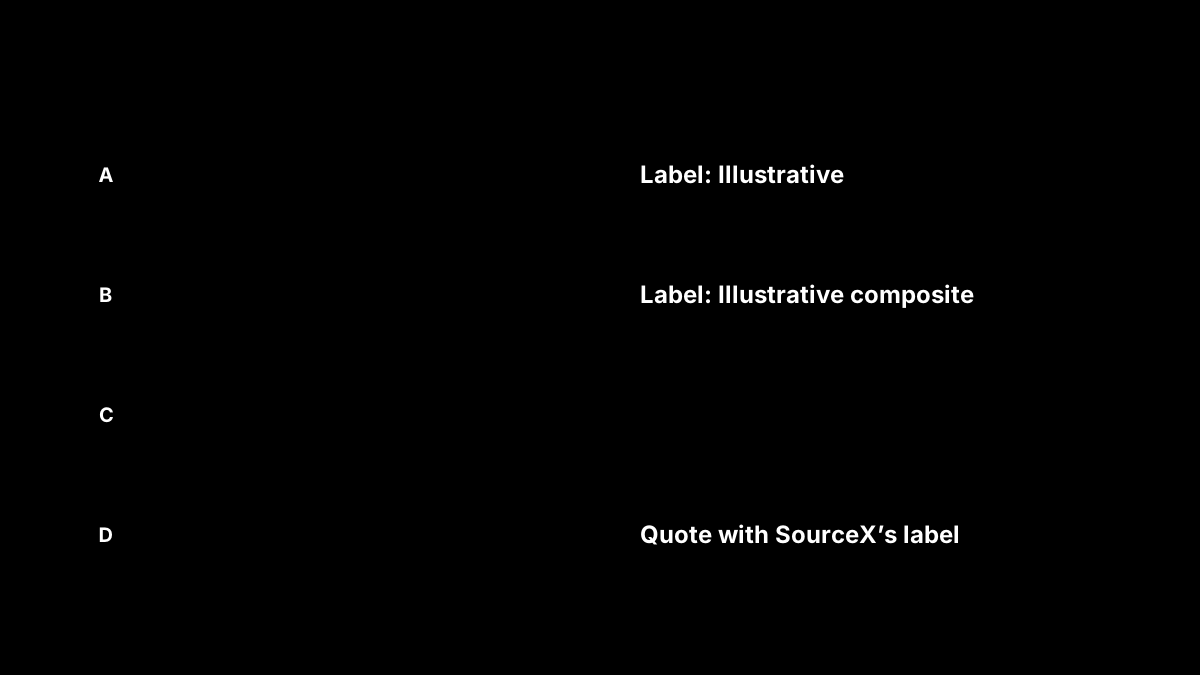
| Class | What it is | Label | Names and people | Numbers | In partner content? |
|---|---|---|---|---|---|
| A. Invented | A company made up from SourceX's published screening profile | "Illustrative" as the first word, plus a line saying no real company, deal or result is shown | A plain descriptor such as "a 220-person freight broker" | Headcount, years and durations; reward arithmetic only in symbols | Yes |
| B. Composite | Invented from patterns seen across many companies, with no single source | "Illustrative composite" plus the same line | A plain descriptor; no detail that points to one company | As for class A | Yes, if no element traces to one company |
| C. Disguised real | One company you know, renamed or lightly altered | No label works, because it is a real company | Identifying even when renamed | Real figures that belong to the company | No; start again as class A |
| D. SourceX-published | Material SourceX has put on its own live pages | SourceX's own label, kept verbatim, with a link | Only as SourceX published them | Only as SourceX published them | Quote or link as published; never extend |
Two rows need emphasis. Class C is the one reviewers miss, because it arrives looking like class A: the writer changed the name and believes the job is done. And class D is narrow. The customer names and case material SourceX chooses to publish are on its pages; a partner adds nothing to them and never writes a SourceX case study of its own.
When an example must show a reward, use the terms' own definition in symbols: the reward is the greater of $50,000 plus 5% and 15% of P, where P is the Actual Supplier Payout SourceX actually paid the company. SourceX's payout calculation examples model the habit, describing each example as hypothetical and marking it illustrative in its heading, and the referral earnings calculator does the arithmetic from the published program. Section 5 of the terms adds that "Estimates shown in the portal or calculator are projections, not promises."
Ten tests an Illustrative example must pass
- The label opens the example. "Illustrative" is the first word a reader meets, not a footnote.
- The label sits inside every graphic and slide that shows the example. Screenshots and forwarded slides travel without captions.
- The label reaches the preview. When the example is the subject of a page or post, put the word in its title or summary, because link previews and search snippets show those and nothing else.
- No invented brand names. "Northwind Freight" reads as a company and may already be one. Use a descriptor.
- No invented quotes from invented people. If the example needs a voice, write the question a CEO might ask and label it as a question.
- No photos, logos or headshots that suggest a real business or real staff.
- No dollar payouts, offers or reward amounts. Use stages, durations and counts; show reward arithmetic only in symbols.
- Conditional verbs for outcomes. "Would be reviewed" and "could be declined", never "was accepted" or "got paid".
- No customer vocabulary. An invented company is never a customer, a client of SourceX, a partner company or "one of ours".
- A stated failure point. Name at least one place the example could stop, such as a rights question or a missed size test. An example that cannot fail reads as a promise.
Evidence, scope, timing and permission for anything real
Classes C and D, and any sentence that states a real fact, pass four further checks before they go out.
- Evidence. The live SourceX page behind the sentence and the date you read it. If the page has changed or gone, so does the sentence.
- Scope. Quote whole, including SourceX's label. Do not add figures, industries or outcomes the page lacks, and do not blend SourceX's illustrative cases with facts from your own clients.
- Timing. SourceX updates its pages, so check again before each reuse rather than relying on last quarter's copy.
- Permission. Section 4.5 of the sample partner agreement reads: "Neither Party may publicly identify the other as a partner or disclose non-public deal details without written authorization, except as legally required." The same agreement treats introduced contact identities and introduction records as confidential information. A partner does not publish that it introduced a named company, however the company feels about it.
Reworking a disguised example (Illustrative)
Before: "One of our clients, a Midwest freight broker with about 200 staff, licensed six years of dispatch notes through SourceX this spring. 'It was the easiest yes we made all year,' says its COO."
Everything here reads as real: a client, a region, a size, a season, a quote and a completed deal. If it was drawn from an actual client, those details may be enough to identify the company, and the quote may be a sentence its COO never said.
After: "Illustrative: an invented 220-person freight broker with ten years of dispatch notes in one system. In this example, the first question its CEO would ask is whether those notes belong to the broker or to the shippers it serves, which SourceX's rights review answers, not the partner. No real company, deal or result is shown."
The rewrite is less vivid and more useful. It teaches a real step, names a point where the example could stop and claims nothing. The underlying question, whose records they are, has its own guide: company data versus data owned by its customers.
When a reader asks whether a company is real
Answer plainly and at once: "No. It is an invented example. SourceX publishes what it chooses to say about real companies on its own pages, with its own labels, and I can point you there." Do not add "but it is based on someone I know". That sentence turns a class A example into a class C problem after the fact.
If you publish research that counts introductions rather than inventing companies, a different review applies: publishing network research without exposing companies.
Where the standard falls short
- Composite and disguised can blur. When a composite leans on one company more than the others, treat it as class C.
- Labels can be cropped. A determined reader can strip any label, so write examples that stay harmless without it: no real-sounding names, no real figures.
- It is not legal advice. Whether advertising rules reach partner content depends on facts and jurisdiction; your counsel decides.
- Linked pages change. A SourceX page you quoted may be revised; the timing check above is the only defense.
Next step
Refer a company. No cap on rewards. Default reward on a company's first qualifying transaction: the greater of $50,000 plus 5% and 15% of Actual Supplier Payout, with no cap; further qualifying transactions first agreed within 12 months of the first Closing pay 15%. Eligibility and payment conditions apply, including the USD 100,000 Minimum Transaction, and a signed Schedule A or addendum can differ. A lead, meeting or signature alone does not trigger payment.
With every example in your materials sorted and labeled, register as a partner, build new examples from the screening profile on who qualifies rather than from clients, and keep the program terms version you relied on next to each approved deck.