

The business task: grant a temporary exception, then prove it ended
A control cannot be met for a while, so the company approves an exception: a finance user keeps conflicting permissions during a system cutover, or a contractor account stays open past its review date. The approval names an owner, a reason and an end date. When the date arrives, someone has to take the permission away and someone else has to test the control again and record that it works. Auditors ask for exactly this sequence, and it is where judgment shows: who accepted the risk, for how long, and what they did when the deadline slipped.
Each step lives in a different system and belongs to a different team. Risk or internal audit approves the exception in a governance, risk and compliance tool. IT security changes the access in the identity provider. IT operations logs the request and the eventual clean-up in a service desk. NIST SP 800-53 control enhancement AC-2(2) describes the intended behavior for temporary accounts: removal or disabling after an organization-defined period, automatically. Many companies set the end date in the governance record only, which is where the chain starts to drift.
What metadata can a referral partner collect about control-exception-to-remediation without reading private content?
A partner can collect a packet of systems, years, object types, volume bands, linkage owners and unknowns. Nothing in it comes from inside an approval note, an access log or a ticket.
| Packet field | Example entry (Illustrative) | Who can confirm it |
|---|---|---|
| Governance tool | Exceptions and control tests since 2019; spreadsheets before that | Head of risk or internal audit |
| Identity provider | In use since 2018; audit logs exported to storage since 2022 | IT security lead |
| Ticketing | Access requests and removals since 2016 | IT operations manager |
| Volume band | Dozens of exceptions a year; thousands of access tickets | Head of risk and IT operations manager |
| Where the end date takes effect | Governance record only for most exceptions; on the grant for a few apps | IT security lead |
| Exception-to-ticket join | Exception ID in access ticket: since 2021 | IT operations manager |
| Control-test evidence join | Test evidence attached: inconsistent | Head of risk or internal audit |
| Unknown | Whether approval reasons name individuals or customers | General counsel |
| Unknown | Whether pre-2022 identity events still exist anywhere | Unknown until reviewed |
The "where the end date takes effect" line is the single most useful entry. It tells SourceX how often the governance record and the access reality are likely to have diverged, and so how much of the story sits only in tickets.
What breaks when an expired exception remains active in a separate system
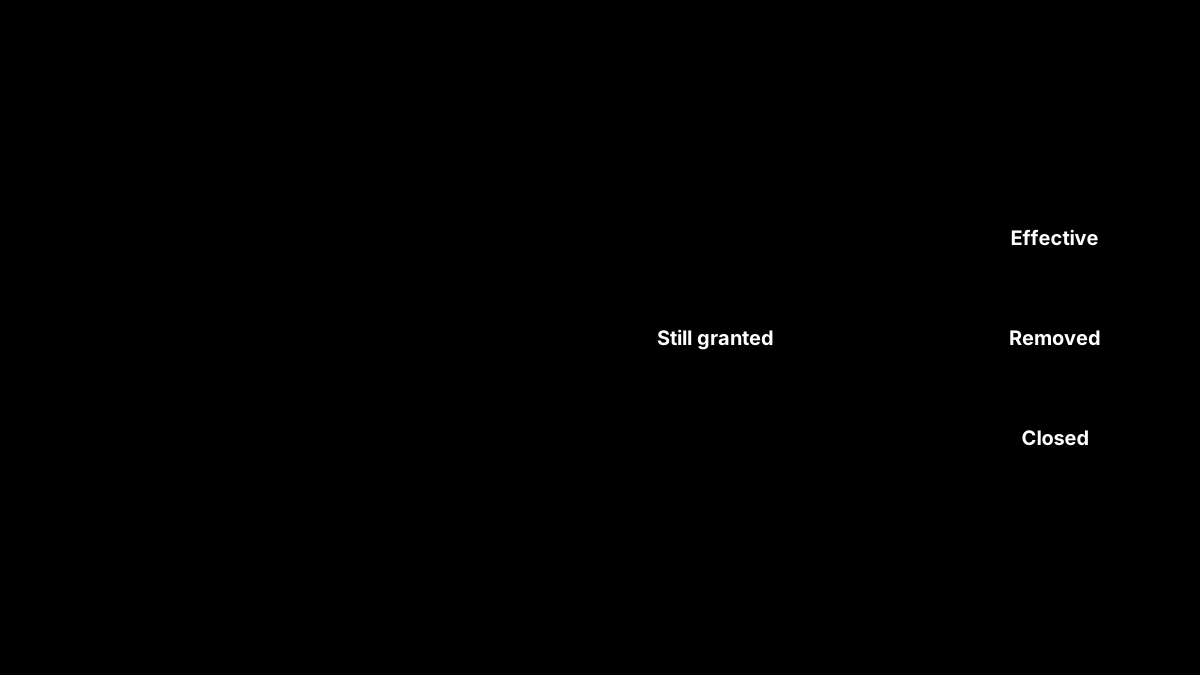
The records disagree, and each one looks right on its own. The graphic on this page follows one Illustrative 30-day segregation-of-duties exception at a fictional insurance administrator. The GRC tool approves it on day 1 and marks it expired on day 30, then shows the control as compliant. The identity provider never received the end date, so the access stays granted. The access request ticket closed on day 1, and no removal ticket exists until an access review flags the account on day 95. The access is removed and the control verified effective on day 97. For 64 days, the GRC record and the identity provider told different stories.
Log retention decides whether anyone can prove those 64 days later. Microsoft Entra keeps audit logs for 7 days on the free tier and 30 days on P1 and P2 unless they are routed to storage, and Okta System Log queries do not return events older than 90 days. Where an access package expiry is set on the grant itself, Entra removes the access when the assignment expires, though changes can take up to 24 hours to apply.
 Okta
That is why the packet asks two metadata questions about the identity side:
| Question | Illustrative answer | Owner |
|---|---|---|
| Are identity audit logs exported to storage, and since when? | Exported since 2022; nothing older | IT security lead |
| For how many exceptions is the end date set on the grant itself? | A few apps only | IT security lead |
Answers like these let SourceX estimate how many exceptions can be reconstructed end to end without anyone reading a log.
Who can authorize the introduction, and what stays unknown
Control owners can describe the chain; the CEO has to authorize a licensing discussion, usually with the CFO, CIO, chief risk officer or general counsel advising, because exception and access records touch security, employees and auditors. Compliance consultants who work on these programs can find the partner route on the compliance consultant page; the compliance and governance data type describes the wider record family.
The company baseline: 50+ full-time employees at peak (contractors excluded), documented operating history, rights to license, and an authorized contact. Companies in the U.S., Canada and the EU qualify, as do companies in the UK, Australia, New Zealand, India, Singapore, South Africa, Latin America, the UAE and Saudi Arabia when at least 70% of the data is in English.
Unknown until SourceX reviews it under the company's own agreement: whether the company's rights and audit commitments allow any use, what security detail must be removed or excluded, how complete each hop is, and whether a buyer wants the result. SourceX does not claim a connector for every GRC tool, identity provider or ticketing system, and a partner should not promise one. More system pages sit under systems.
Go deeper on control-exception-to-remediation records
- How GRC, identity and ticketing records link end to end: a record-chain table of each step, its record, its key and its system.
- Control-exception-to-remediation completeness checklist: a pass, partial or fail scorecard for judging whether the records are complete enough to discuss.
- What a single-system export of an exception leaves out: one Illustrative case read before and after its surrounding context is added.
Next step
Refer a company. No cap on rewards. Default reward on a company's first qualifying transaction: the greater of $50,000 plus 5% and 15% of Actual Supplier Payout, with no cap; further qualifying transactions first agreed within 12 months of the first Closing pay 15%. Eligibility and payment conditions apply, including the USD 100,000 Minimum Transaction, and a signed Schedule A or addendum can differ. A lead, meeting or signature alone does not trigger payment.
If a client can say, at the metadata level, where its exception end dates take effect and how removals are recorded, and an officer will take the call, register as a partner, check the company against who qualifies, and read the terms before you submit.