

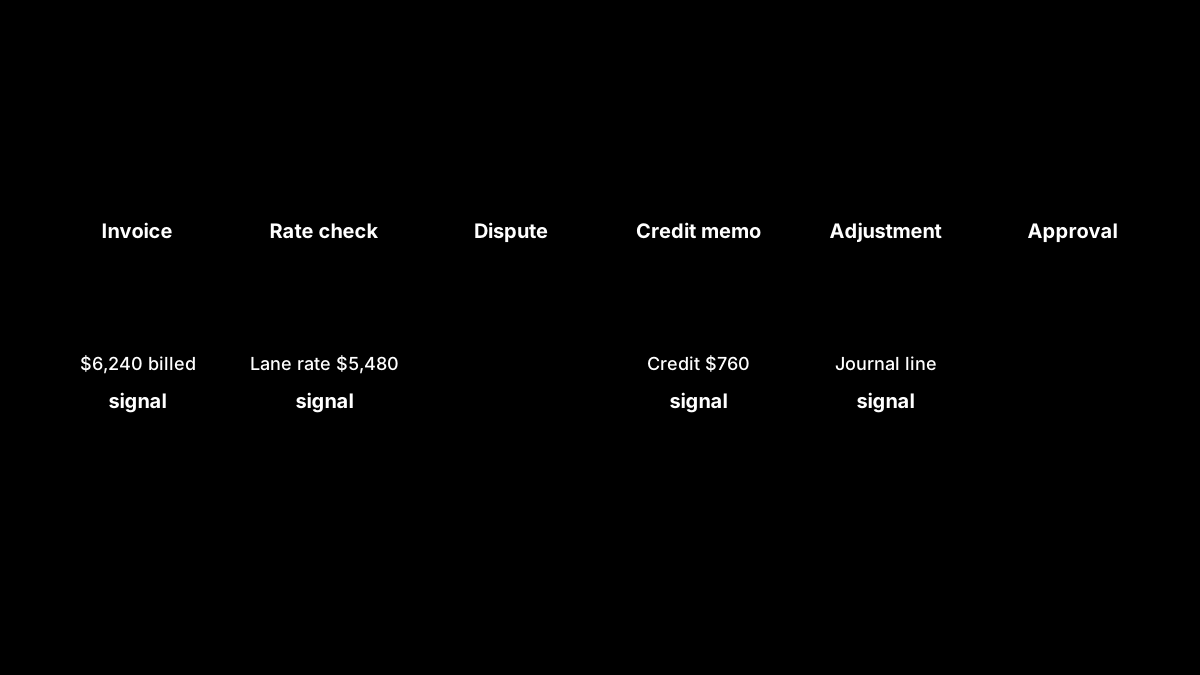
This page is part of the reinforcement learning with verifiable rewards guide, which explains the training method. Here the job is narrower: one workflow, played end to end.
Where the term comes from, in two sentences
The Tulu 3 paper from the Allen Institute for AI named the method Reinforcement Learning with Verifiable Rewards: a verification function replaces a learned reward model, and the model is rewarded only when its output is verifiably correct. DeepSeek-R1 describes the same idea with rule-based accuracy rewards, for example requiring math answers in a fixed format so a rule can check them and running test cases against code.
Business processes produce the office equivalent of a test case whenever an action can be compared with an agreed document: a contract rate, a price list, a policy limit.
The workflow, played end to end
Illustrative and fictional. A 420-person building-supplies wholesaler pays a regional carrier under a signed rate agreement. One invoice arrives for $6,240 on a lane where the agreement sets $5,480. An accounts payable specialist runs the dispute; the AP manager approves the fix.
| Step | What happens | Decision taken | Record left behind |
|---|---|---|---|
| 1. Invoice received | Carrier invoice for one shipment, $6,240 | Route to freight audit | Invoice image and header in the AP system |
| 2. Rate check | Specialist compares invoice to the rate agreement lane price, $5,480 | Flag a $760 variance | Audit note citing the agreement version and lane |
| 3. Dispute opened | Short-pay request sent to the carrier | Hold $760, pay the rest | Dispute ticket with timestamp and carrier reference |
| 4. Carrier response | Carrier issues a credit memo for $760 | Accept the credit | Credit memo document linked to the ticket |
| 5. Ledger adjustment | Adjustment posted against the invoice, referencing the credit memo | Apply the credit to the open balance | Journal line with amount, account, period and memo reference |
| 6. Approval and close | AP manager approves; next payment run nets the credit | Close the dispute | Approval with name and time; ticket closed; no reopen within 60 days |
Six steps, six records. A reviewer reading only the final balance would see a paid invoice. A reviewer with all six records sees an error, the rule that exposed it, the action that fixed it and evidence that the fix stood.
The verifiable check, written as rules
The end state is correct only if every condition below is true. Each one is a yes or no that a program could test from the records.
- The adjustment amount equals the credit memo amount ($760).
- The invoice amount minus the adjustment equals the rate agreement price for that lane ($6,240 minus $760 equals $5,480).
- The rate agreement version cited in the audit note was in force on the shipment date.
- The adjustment posts in the same period as the original invoice, or the period the policy names.
- The approver is not the person who posted the adjustment.
- The dispute was not reopened and no reversing entry followed within 60 days.
Condition 2 is the heart of it: an explicit arithmetic test against an accepted document. Conditions 3 and 5 depend on records many companies do not keep well, which is why the same workflow can be checkable at one company and only describable at another.
Which records carry the signal, and which are context
| Record | Role in an AI-data review | Why |
|---|---|---|
| Rate agreement with version and effective dates | Signal | It is the rule; without it, nothing can be scored |
| Invoice and credit memo | Signal | They hold the amounts the rule compares |
| Journal line with memo reference | Signal | It is the action whose correctness is checked |
| Audit note | Context, sometimes signal | It shows reasoning; it becomes signal if it names the agreement version |
| Dispute ticket and carrier emails | Context | Useful for reconstructing the task, but not needed for the yes or no |
| Approval record | Signal for control checks | Confirms preparer and approver differ |
The pattern travels. A tool call that must return a specific value, a pricing override that must stay within a limit, or a refund that must match a policy all work the same way; tool-use training data and what operational data is describe the wider family, and the logistics workflow example pack shows more chains from freight and warehousing.
From the example to an introduction
An introducer does not need to explain RLVR to a client. The useful questions are about the records: is the rule kept with its version, does the action reference the document it relied on, and is the final outcome linked back. The qualification scorecard turns those questions into strong, borderline and weak fits, and the review packet lists the metadata-only documents a company would prepare if it proceeds.
Partners stay at metadata level: which workflows, which systems, how many years, roughly how many items a year, and who owns them. They never handle invoices, ledgers or exports. The company also needs 50+ full-time employees at peak (contractors excluded), documented operating history, rights to license and an authorized contact. Companies in the U.S., Canada and the EU qualify, as do companies in the UK, Australia, New Zealand, India, Singapore, South Africa, Latin America, the UAE and Saudi Arabia when at least 70% of the data is in English.
What stays unknown until SourceX reviews it: rights to the records, including carrier and customer terms; which entities and years are in scope; how counterparty details are de-identified; and whether any buyer wants this record type. SourceX licenses approved business data directly from companies for AI training and evaluation and manages agreement, rights review, data preparation, delivery and payout.
Next step
Refer a company. No cap on rewards. Default reward on a company's first qualifying transaction: the greater of $50,000 plus 5% and 15% of Actual Supplier Payout, with no cap; further qualifying transactions first agreed within 12 months of the first Closing pay 15%. Eligibility and payment conditions apply, including the USD 100,000 Minimum Transaction, and a signed Schedule A or addendum can differ. A lead, meeting or signature alone does not trigger payment.
If a client's disputes, adjustments and rule versions link the way this example does and the owner wants to explore licensing, register as a partner, check the company on who qualifies and read the program terms.